
Data engine
Ingestion, validation and reconciliation of the loan book, with exceptions surfaced before they reach the calculation.
Risk BI Platform
One governed platform for expected credit loss, stress testing, ICAAP and ILAAP — calibrated to how your regulator actually supervises you.
The problem
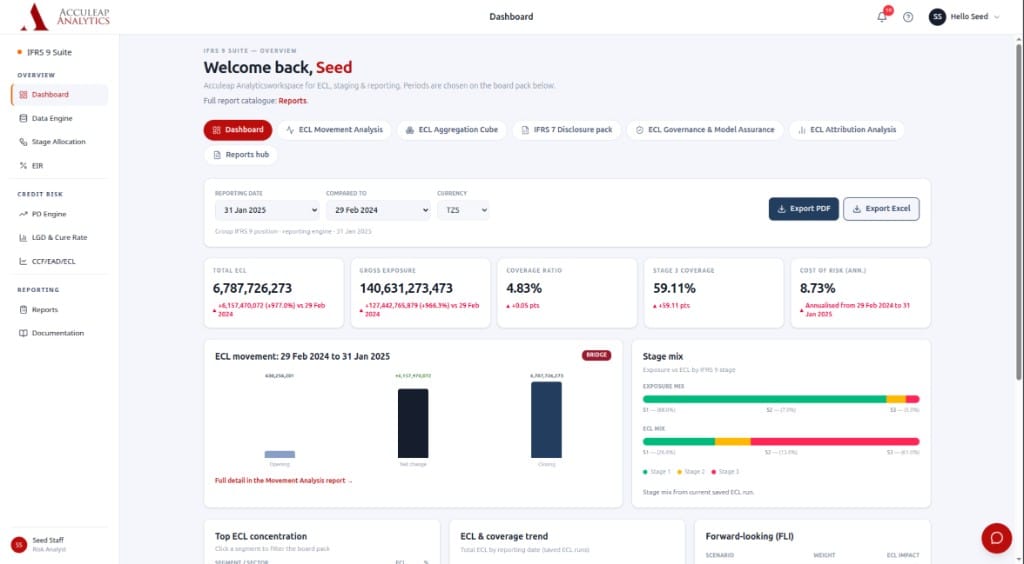
The Risk BI Platform runs your entire IFRS 9 process as a governed system, with stress testing built into the same engine. The same inputs produce the same result, on demand, months later. Every figure traces back to source data through a visible calculation path. And the process survives the departure of whoever built it.
You already know what your ECL process looks like. A chain of linked workbooks. One person who fully understands it. No version control, no calculation lineage, and an audit trail that has to be reconstructed after the fact rather than produced on request.
So the reporting window is spent rebuilding the model rather than interpreting the result. Your auditor asks how a staging decision was reached and the answer takes three days to assemble. Your regulator queries a number and the honest response is that it will be addressed next quarter. And the whole apparatus depends on one person who could resign.
Then the same team, on the same foundation, is asked to produce ICAAP, ILAAP and a monthly or quarterly supervisory stress test.
None of this reflects the quality of your modelling. It reflects the fact that a spreadsheet is not a system.
Platform
Ingestion, validation and reconciliation of the loan book, with exceptions surfaced before they reach the calculation.
PD estimation and calibration, term structures, and through-the-cycle to point-in-time conversion.
LGD estimation with recovery and collateral treatment.
EAD including credit conversion factors for undrawn commitments.
SICR assessment and stage allocation, with the trigger logic visible and versioned rather than buried in a formula.
EIR computation and unwinding.
Scenario definition, weighting and forward-looking adjustment to PD.
Scenario design and execution for ICAAP, ILAAP and periodic supervisory stress tests.
Dashboards, disclosure tables and the reconciliations your finance team needs to close.
The same inputs produce the same result on demand, months after the fact.
Every number traces back to source data through a visible path. When an auditor asks how a figure was reached, the system answers.
Every methodology change is recorded, dated and attributable, with maker-checker controls on the changes that matter.
The process does not live in one person’s head or one person’s workbook. A team can run it, and a new joiner can learn it.
Performance
An ECL run that typically takes two to three days on a spreadsheet model completes in hours.
The time saved is the smaller half of that. What actually changes is that re-running becomes practical. You can test a staging assumption, re-run under a different macroeconomic scenario, answer a supervisor’s question or respond to an audit challenge within the same day — rather than committing to address it in the next reporting cycle. You stop running one scenario because one is all there is time for.
Implementation
On-premise, within your own network. This is how our clients run it and what we recommend. A hosted option is available where an institution prefers it.
Web application on a standard Microsoft stack — Internet Information Services and SQL Server. For smaller institutions both components can sit on a single virtual server.
APIs are available for connection to most core banking platforms.
Typically six to eight weeks from contract to live use.
From Nairobi and Kigali, by the team that built the credit logic.
The platform runs inside your network. Customer-level information remains entirely in your custody and within your jurisdiction, which is what supervisors in this region expect. We do not receive individual borrower records.
Evidence
Banks, microfinance institutions, SACCOs, consumer credit providers and insurers that report under IFRS 9 and are supervised under a Basel-based capital regime. It is scoped and priced for institutions that cannot justify a global vendor implementation, and it scales down as readily as up.
Next step
A demonstration takes an hour and uses your data. We will show you the calculation lineage, the staging logic and the audit trail — the three things your auditor asks about first.